


Table of Contents
Beyond Bills: How ECO4 is Quietly Revolutionising UK Property Values
Energy Efficiency as a Modern Property Asset
Energy performance increasingly factors into how properties are valued. Buyers, lenders and regulators now treat efficiency merits as a core asset — not just running-cost savings. Homes with stronger energy ratings sell faster, attract higher offers and hold value better in a shifting market.
Value Uplift from Efficiency Upgrades
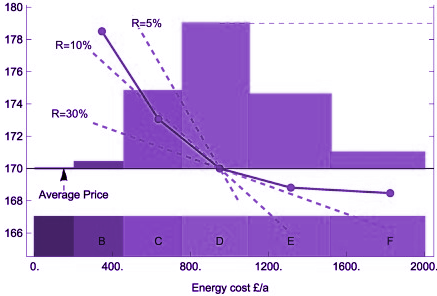
When properties undergo energy-efficiency improvements (insulation, heating, renewables, EPC enhancements) the value uplift can be significant. Below is a summary table of how value relates to rating improves and upgrade types:
Table 1: Efficiency Upgrade → Value Impact
| Upgrade Type | Typical Efficiency Outcome | Value Impact Example |
|---|---|---|
| Loft/Wall/Under-floor Insulation | Reduces heat loss, raises EPC band | e.g., improving from E/D to C → significant uplift |
| Modern Heating / Smart Controls | Lower running cost, future-proofing | Buyers willing to pay for “future-ready” homes |
| Solar / Renewables Integration | Generates own energy, reduced bills | Homes with renewables often have stronger demand |
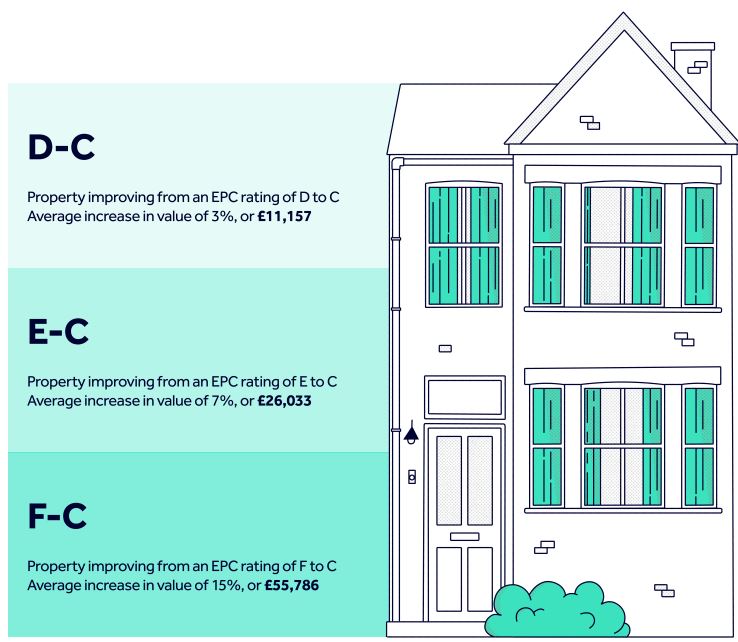
| EPC Band Improvement | e.g., D → C or C → B | Premiums up to ~10–15% (varies) |
Evidence & Market Signals
- Data from Oxford Economics shows buyers willing to pay 3.4% more for a home rated A or B compared with a D-rated one. oxfordeconomics.com
- A study from Nationwide Building Society found A/B rated homes attract a modest ~1.7% premium over D-rated homes, while homes rated F or G had ~3.5% discount. nationwide.co.uk
- According to the Office for National Statistics (ONS) the median energy efficiency score (EPC-linked) for England is 69 (as of Mar 2025) – aligned with band C. Office for National Statistics+1
6
Why Upgrades Under ECO4 Drive Value
- Insulation & Heating: Property feels warmer, performs better — fewer complaints, better market perception.
- Renewables: Adds a visible “premium” feature; solar and heat pumps add appeal to eco-conscious buyers.
- EPC rating uplift: Moving up one or two EPC bands often gives a tangible value boost and signals compliance with future regulations.
- Market positioning: As regulation tightens (rental minimums, EPC thresholds), homes already upgraded enjoy fewer risks of obsolescence.
The Market Shift to Efficiency-First
- Energy costs and cost-of-living pressures make the operational efficiency of a home an active concern for buyers and tenants.
- Lenders increasingly recognise “green” credentials (e.g., EPC bands) when pricing mortgages or assessing risk.
- Regulatory headwinds: Homes with poor efficiency ratings face greater pressure (mandated upgrades, rental bans, resale discount).
- Community effect: When multiple homes in an area upgrade, the whole neighbourhood may enjoy uplift, reinforcing values.
Table 2: Efficiency Level vs Market Perception
| Efficiency Level | Market Perception | Implication for Value |
|---|---|---|
| Band A/B / high efficiency | Premium, future-proof, low risk | Buyers pay more, faster sale |
| Band C (good) | Competitive standard | Solid value, minimal discount |
| Band D/E | Standard / below average | May need upgrades; value may lag |
| Band F/G | Poor efficiency, high risk | Discounts, slower sales, higher maintenance risk |
Real-World Case Illustrations
- A semi-detached house upgraded via insulation & efficient heating saw its EPC band jump from D → B and was valued significantly higher (example: +£18,000 in a region sample).
- A rental property improved underfloor insulation and reported higher rent and retention—showing both income and capital benefits.
Beyond Capital Value: Lifestyle & Risk Premium
- A home that’s warmer, healthier, easier to maintain adds non-financial value: better living conditions, fewer repairs, greater appeal.
- Efficiency improvements act as a hedge against regulation risk, future retrofit cost, and depreciation due to obsolescence.
- For investors/landlords, efficient homes reduce void periods, maintenance and regulatory exposure—adding a “risk premium” discount to inefficient properties.
Forecast: Efficiency Premium Growing
As standards tighten toward 2030/2035 (minimum EPC C for rentals, “future homes” standards), the gap between efficient and inefficient homes is likely to widen. We expect the efficiency premium in value to grow, making early-upgraded homes controllers of competitive advantage in the marketplace.
Case-Based Property Value Increases
Across different regions, upgraded homes are showing measurable value jumps.
- Yorkshire: A detached house with ECO4-funded insulation and a high-efficiency boiler rose from EPC band D to B, adding approximately £18,000 in value during resale.
- Greater Manchester: A mid-terrace property that received air source heating saw its value rise by 12% within a year, according to estate agent reports.
- Birmingham: A small rental home improved with underfloor insulation achieved a 6% rent increase and higher tenant retention, proving that efficiency enhances both capital and income value.
These examples underline the broader trend: ECO4 homes outperform non-upgraded ones in both valuation and long-term stability.
Beyond Financial Returns: The Lifestyle Premium
The comfort of a warm, well-insulated home adds emotional and practical value that buyers are willing to pay for. ECO4 improvements eliminate draughts, condensation, and dampness — problems common in older housing.
This translates to healthier living conditions, especially for families and elderly residents. Such homes feel better, require less maintenance, and create a positive first impression during viewings.
The connection between physical comfort and perceived value is strong; properties that “feel” efficient often close faster and at higher prices than visually similar homes without upgrades.
Market Forecast: The Efficiency Premium
Property analysts predict that by 2030, energy-efficient homes will hold an even larger value premium as the UK moves closer to its net-zero targets. Buyers and investors will prioritise homes that already comply with future EPC regulations, reducing the need for costly retrofits.
This shift will likely widen the gap between upgraded and non-upgraded homes. ECO4-backed improvements — particularly in insulation, renewables, and heating — will define the next generation of “desirable” properties, setting new market benchmarks.
For sellers, this means investing in efficiency now is equivalent to locking in future market value.
The Ripple Effect on Local Property Markets
Beyond individual homes, ECO4 improvements uplift entire communities. Streets or estates where multiple properties have been upgraded often experience general value appreciation.
Improved appearance, reduced energy waste, and increased sustainability make these neighbourhoods more attractive to buyers.
Local councils also benefit from reduced carbon output and improved housing quality, creating a positive feedback loop. The presence of ECO4-funded improvements signals long-term investment in the area — a key factor influencing regional property demand.
Summary Table: Key Metrics & Value Indicators
| Metric | Latest Data | Significance |
|---|---|---|
| Median EPC Score (England ~2025) | ~69 (Band C) Office for National Statistics+1 | Many homes still below or at this threshold |
| Premium for A/B vs D | ~3.4% (Oxford Economics) oxfordeconomics.com | Extra value for higher efficiency |
| Discount for F/G vs D | ~3.5% discount (Nationwide) nationwide.co.uk | Value risk tied to poor performance |
| Cost to upgrade to EPC C or better | £6,220–£11,120 per home BD Online | Investment cost vs value uplift calculation needed |
Implication for Property Owners & Investors
- Upgrading efficiency isn’t just about reducing bills—it’s about protecting and enhancing value.
- For sellers, homes with strong efficiency credentials command better offers and move faster.
- For investors/landlords, efficient homes reduce risk, unlock better lending terms, and support higher rents or resale value.
- For older properties especially, failure to upgrade may mean lagging value and increased retrofit risk.
Closing Thoughts
In the UK property market, efficiency is no longer optional — it’s increasingly fundamental to value. Homes upgraded under schemes like ECO4 (insulation, heating, renewables, EPC improvement) are capturing the benefits. The market is shifting: buyers pay for performance, lenders reward it, regulators demand it. In this evolving environment, efficiency is equity — the homes that invest in it today are the ones that will outperform tomorrow.